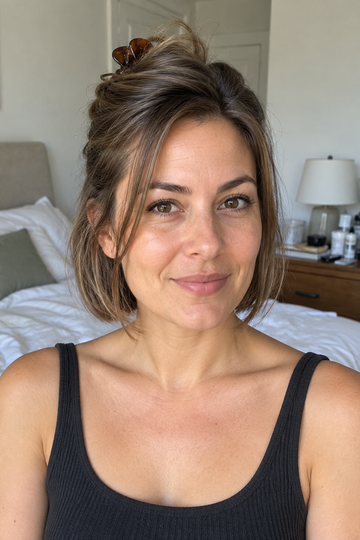
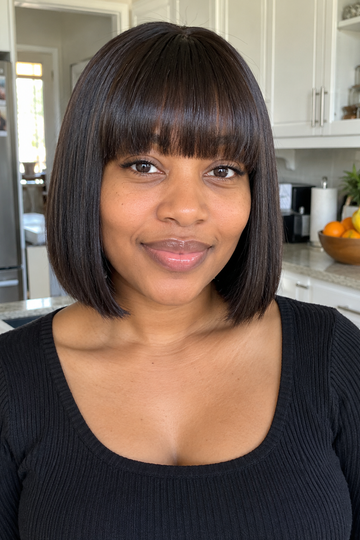
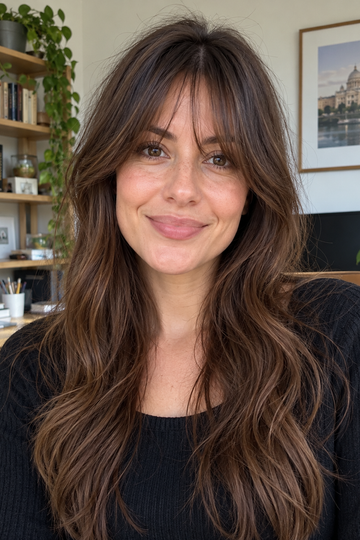
The wave is the whole point here, not the length. A short cut that would fall flat and grown-out on straight hair comes alive on wavy hair, because the bends and movement supply exactly the volume that shorter styles need. That is good news after 50, when hair often loses some of its density, since your natural texture does the lifting that products otherwise have to fake. The trick is working with the wave instead of flattening it.
Jump to:
- Wavy Pixie
- Shaggy Wavy Pixie
- Wavy Bixie
- Wavy Textured Crop
- Short Wavy Bob
- Wavy French Bob
- Wavy A-Line Bob
- Short Wavy Shag
- Curtain Bangs on Short Waves
- Side-Swept Bangs on Short Waves
- Wispy Wavy Fringe
- Face-Framing Layers on Short Waves
- Soft Beachy Short Waves
- Tousled Textured Waves
- Vintage Finger Waves
- Permed Body Waves
- Voluminous Wavy Blowout
- Deep Side-Part Short Waves
- Middle-Part Short Waves
- Silver Short Waves
- Salt-and-Pepper Short Waves
- Blonde Short Waves with Highlights
- Dimensional Lowlights on Short Waves
- Natural Wavy Short Cut
Wavy Pixie

A wavy pixie is one of the most flattering short cuts going, especially as hair thins a little with age. Cropped short with the natural wave left to move on top, it gives lift, softness, and a modern shape all at once. The wave keeps it from looking severe the way a sleek pixie can. It does ask for a trim every four to six weeks to hold its shape, since a pixie grows out of its magic quickly. Worth every visit.
Shaggy Wavy Pixie

Add shaggy, textured layers to that pixie and you get something with real personality. The extra layers break the shape into piecey, tousled sections that catch the wave and add volume and attitude. It is a touch edgier than a classic pixie and hides fine hair well, since all that texture disguises thinner spots. Finish with a little texture cream and your fingers rather than a brush, so the layers stay separated and undone instead of smoothed flat.
Wavy Bixie

The bixie, a hybrid of a bob and a pixie, has become a favorite for wavy hair after 50, and it is easy to see why. Sitting between chin and jaw length, it keeps the fullness of a bob with the lift of a pixie, and the wave adds body all through it. It grows out kindly, which softens the commitment of going short. Ask for plenty of internal layering so the waves have room to open up without puffing out.
Wavy Textured Crop

A textured crop sits just below the ears with enough internal layering to let the wave pattern open up. On wavy hair the movement does the work, so it looks full and shaped rather than flat. One honest note, this cut needs natural wave, on straight hair it just looks like a grown-out pixie. It suits oval and longer faces best, since the soft width at the cheekbones can widen a rounder face. Point-cutting keeps it from puffing.
Short Wavy Bob

The short wavy bob, cut at the chin or just below, is a classic for a reason. The length is long enough to show off the wave and short enough to keep its bounce, and it frames the face beautifully as features soften with age. Layered ends stop it from looking blunt and heavy. Skip the flat-iron and let your wave do its thing with a curl cream and a diffuser, since fighting the texture straight defeats the whole point of the cut.
Wavy French Bob

A French bob keeps things shorter, right at the chin, and pairs the cut with a soft fringe. On wavy hair the fringe picks up a little bend and looks relaxed rather than fussy, and the short length is fresh and youthful. It suits anyone wanting a lower-effort take on the wavy bob. Keep the fringe soft and slightly wispy, since a heavy blunt fringe can look severe and date the whole look on mature hair.
Wavy A-Line Bob

An A-line bob cut short angles the front pieces a touch longer than the back, and the wave softens that angle into something gentle rather than sharp. The longer front frames the jaw, which flatters as the jawline changes over the years, while the shorter back adds lift. Keep it short, chin-length at the front, so it stays firmly a short cut. A round brush at the roots plus air-dried waves through the ends gives volume up top and movement below.
Short Wavy Shag

The shag has come roaring back, and a short version with waves is genuinely age-friendly. All those layers give the wave somewhere to move, building volume and a bit of rocker edge that keeps a mature cut from looking staid. Pair it with curtain bangs for the full effect. The honest catch is that a shag can look stiff if you over-style it, so use a flexible-hold spray and a diffuser to keep the layers soft and touchable rather than crunchy.
Curtain Bangs on Short Waves

Curtain bangs are flattering at any age, and they work on short hair too, not just longer cuts. Split down the middle and sweeping open on either side, they frame the face and soften forehead lines without the heaviness of a full fringe. On wavy hair they fall with a natural bend that keeps them from looking too neat. They blend into a bob or a pixie as they grow, so there is no awkward stage to dread.
Side-Swept Bangs on Short Waves

Side-swept bangs graze the cheekbone at an angle, and they do something kind for a mature face, drawing the eye across and softening the features. On a short wavy cut they add a little extra movement at the front where you notice it. They suit a pixie or a crop especially well. The diagonal sweep uses less hair than a straight fringe, so it looks softer and works even if your hairline has thinned a touch at the temples.
Wispy Wavy Fringe

A wispy fringe is the softest bang option, made of fine, feathered pieces that barely touch the forehead. It suits fine or thinning hair especially well, since it does not need much density to look right, and the airy quality keeps it light and youthful. On wavy hair the pieces bend gently and frame the eyes. Keep it trimmed regularly, since a fringe grows into your line of sight faster than you expect, and a little movement is all it needs.
Face-Framing Layers on Short Waves

A few soft layers cut around the face are the gentlest way to shape short wavy hair without any fringe at all. Left long around the front, they catch the wave and soften the line along your cheeks and jaw. There is nothing to grow out awkwardly and nothing to style beyond scrunching in a little product. It is the low-commitment option for anyone who wants softness around the face but is not sure about committing to bangs.
Soft Beachy Short Waves

Soft, loose beachy waves keep a short cut looking current and relaxed. Rather than tight, uniform curls, which can look dated on mature hair, these are gentle, undone bends that add width and movement. You can coax them out with a large-barrel wand or an overnight braid, then break them up with your fingers. A texture spray gives grip without stiffness. The looser and more irregular the wave, the more natural and youthful the whole thing looks.
Tousled Textured Waves

Tousled waves take the undone idea a step further, all piecey separation and lived-in movement with no attempt at neatness. It is a great way to wear short wavy hair day to day, since a bit of mess is the whole look and imperfection works in your favor. Scrunch in a texturizing cream on damp hair and let it air-dry. This is the lowest-effort style here, which makes it a favorite for anyone who would rather not fuss each morning.
Vintage Finger Waves

For a dressed-up moment, finger waves bring old-Hollywood glamour to a short cut. The hair is molded into deep, sculpted S-shaped ridges that hug the head, a look with real elegance on silver or dark hair alike. It is a set style rather than an everyday one, and it takes patience and a strong gel to shape. Humidity is its enemy, so save it for a special evening and set it with a firm-hold product to keep those ridges crisp.
Permed Body Waves

If your hair is naturally straight but you love the wavy looks here, a modern body wave perm builds soft, loose waves that last for months. Today's perms are gentle bends, nothing like the tight curls of decades past, and they give straight hair the movement a short cut needs to look full. The honest trade-off is that it is a chemical process, and mature hair can be more fragile, so go to someone experienced and keep up with deep conditioning afterward.
Voluminous Wavy Blowout

When you want the wave with real bounce, a voluminous blowout delivers. Round-brushing short wavy hair as you dry it lifts the roots and shapes the waves into full, springy body, the kind that looks freshly done. It flatters thinning hair by building height at the crown. One caution for round faces, keep the volume up top rather than at the cheekbones, since width at the midface can widen a round face rather than balance it.
Deep Side-Part Short Waves

Switching to a deep side part is the quickest volume trick there is. Parting low on one side forces the hair up and over, building instant lift at the root and a soft sweep of waves across the forehead. It works on any short wavy cut, no scissors needed. It also flatters as hair thins, since the extra root lift disguises a sparser part line. A little dry texture spray at the roots helps hold the height through the day.
Middle-Part Short Waves

A center part brings a balanced, modern symmetry to short waves, with the hair falling evenly on either side of the face. It suits oval and heart-shaped faces particularly well. The one honest caveat, a middle part can flatten the crown and expose the part line, so it flatters fuller hair more than very fine hair. If yours is thinning up top, a soft zigzag part hides the scalp while keeping that centered, even look.
Silver Short Waves

Embracing your silver on a short wavy cut can look genuinely modern, and the texture keeps the color from falling flat. The wave catches the light and gives dimension that a sleek gray never would. Upkeep on the color itself is low once you are fully silver, but do not skip toning, a purple shampoo now and then keeps the silver bright and stops it from yellowing or dulling. A shine product makes the whole thing look healthy and deliberate.
Salt-and-Pepper Short Waves

Salt-and-pepper is the in-between stage, and on short wavy hair it looks rich rather than undecided. The mix of darker strands still threaded through the gray gives natural dimension you cannot get from a bottle, and the wave scatters the two tones into something lively. It is the lowest-maintenance color of all, since you are simply letting nature blend it. A good cut and a little shine serum are all it needs to look deliberate and current.
Blonde Short Waves with Highlights

Not ready to go gray? Soft blonde highlights woven through short waves are a clever middle path, since they blend emerging gray into the blonde so regrowth is far less obvious. The lighter pieces also add brightness around the face, which lifts the complexion. The honest trade-off is upkeep, highlights need a salon visit every couple of months, and blonde wants purple toning to stay cool rather than brassy. But the gray-blending payoff makes it popular for good reason.
Dimensional Lowlights on Short Waves

Lowlights work the opposite way from highlights, weaving darker tones through to add depth and richness rather than brightness. On short wavy hair they make the waves look fuller, since the shifting tones create the illusion of more dimension and density. They are a smart choice if your color has gone flat or you want contrast without going lighter. Lowlights also grow out softly with no harsh line, so the upkeep is gentler than an all-over dye or bright highlights.
Natural Wavy Short Cut

The simplest option is to stop fighting your hair and cut a shape that celebrates its natural wave. A skilled stylist who understands wavy texture will cut to your specific pattern, usually dry, so the finished shape accounts for how the waves spring up. From there your routine can be as simple as a curl cream on damp hair and air-drying. Embracing the texture you have, rather than heat-styling it into submission, is kinder to aging hair and far less work.