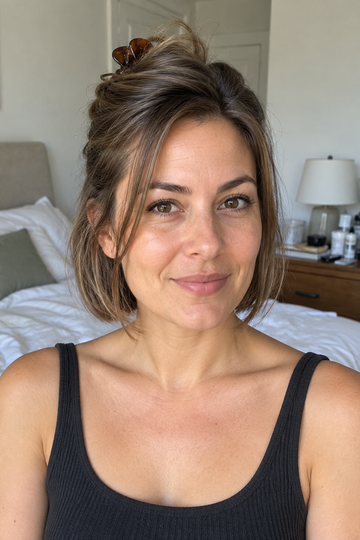
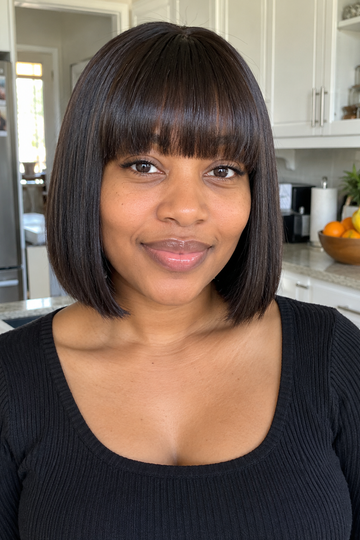
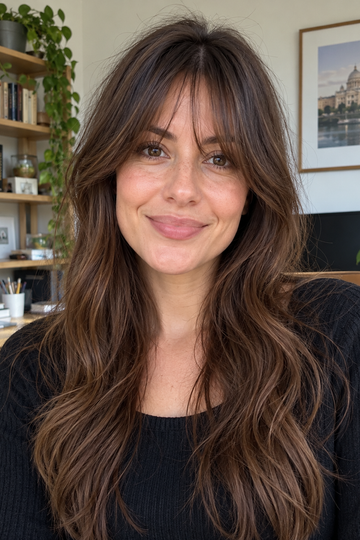
Every round-face haircut guide says the same four words: add length, reduce width. True, and completely useless when you are sitting in the chair trying to describe what you actually want. The part that matters is more specific. Vertical and diagonal lines slim a round face, a side part beats a center one, and layers should start below your chin, not at your cheeks, where they only add width. Get those three things right and almost any length works. Here are cuts that turn the theory into a style you can actually ask for.
Jump to:
- Textured Pixie With Volume on Top
- Long Pixie With a Side-Swept Fringe
- Tapered Natural Cut With Crown Height
- Short Piecey Shag
- Asymmetrical Short Crop
- A-Line Angled Bob
- Collarbone Lob
- Layered Lob With Face-Framing
- Asymmetrical Lob With a Deep Side Part
- Stacked Bob With Crown Volume
- Textured French Bob With a Side Part
- The Hush Cut
- The Butterfly Cut
- Long Layers Starting Below the Chin
- Shag With Curtain Bangs
- The Wolf Cut
- Shoulder-Length Cut With Curtain Bangs
- Long V-Cut With Face-Framing
- Long Sleek Hair With a Deep Side Part
- Long Layers With Side-Swept Bangs
- Long Shag With Heavy Movement
- Curly Shag With Height
- Long Curly Layers Shaped Away From the Cheeks
- Soft Modern Mullet
- Feathered '70s Layers
Textured Pixie With Volume on Top

A textured pixie works for round faces when the volume lives up top and the sides stay close. Ask for choppy, piecey layers through the crown to add height, which pulls the eye up and away from the width of your cheeks. Keep it a little longer and messy rather than cropped tight all over. Style it with a bit of paste pushed up and back. Low fuss once it is cut right.
Long Pixie With a Side-Swept Fringe

Grown out into a long pixie with a side-swept fringe, this cut adds the diagonal lines a round face wants. The longer top gives you something to sweep across your forehead, breaking up the roundness at an angle instead of straight across. Keep the sides tucked flat behind your ears. This is a great in-between length if you are growing out a short cut and want it to stay flattering the whole way.
Tapered Natural Cut With Crown Height

A tapered natural cut keeps the sides and back short while leaving height and volume on top, which is exactly what a round face benefits from. The lift at the crown adds vertical dimension while the tapered sides keep width down around the cheeks. Define your curls and coils on top with a light cream so the shape stays full and rounded upward. Low maintenance and bold, and it looks great on tighter textures.
Short Piecey Shag

Short shags bring a lot of movement in a small package. The piecey, wispy layers add texture that keeps the eye moving instead of settling on the roundest part of your face. Ask for shorter layers at the crown for height and longer, feathered pieces at the front to graze past your jaw. A little texture spray brings out the separation. Good for fine to medium hair that needs some shape.
Asymmetrical Short Crop

An asymmetrical crop, longer on one side than the other, builds the off-balance angles that flatter a round face. The uneven lengths pull attention diagonally across your face rather than side to side. Part it deep on the fuller side and let the longer piece fall past your cheekbone. This one takes some confidence and a good stylist, but it is one of the strongest short options for downplaying width.
A-Line Angled Bob

Cut longer at the front and shorter at the back, the A-line bob is one of the best short options for a round face. The front pieces falling just below the chin add length exactly where you want it, while the angle draws a slimming vertical line down each side. Keep a side part to enhance the effect. Sleek or slightly waved both work. Avoid a blunt, chin-length version, which adds width.
Collarbone Lob

Ending right at the collarbone, a long bob gives a round face length without going all the way long. Stopping below the chin keeps the cut clear of the widest point of your face, which is the mistake that makes bobs look round. Add a few soft layers and a side part for movement. This length is easy to style straight or wavy and suits almost every hair type, which is why it stays popular.
Layered Lob With Face-Framing

Face-framing pieces that start below the chin make a layered lob a round face's easy win. The framing traces a soft, slimming line down past your jaw instead of cutting across your cheeks. Keep the ends light and wispy rather than thick and blunt so the whole thing has movement. Tuck the front pieces or let them fall forward. This is the low-drama, high-payoff option most stylists suggest first.
Asymmetrical Lob With a Deep Side Part

Take a lob, add a deep side part, and make one side noticeably longer, and you get an asymmetrical cut that fights roundness from every angle. The deep part adds height at the root while the uneven lengths keep things diagonal. Sweep the longer side across and let it fall past your jaw. Works especially well on straight or lightly waved hair where the clean lines show. A modern, slightly edgy choice.
Stacked Bob With Crown Volume

Shorter and rounded at the back with longer pieces in front, a stacked bob puts volume up at the crown where a round face wants it. The height at the back adds vertical lift while the longer front pieces frame and lengthen your face. Keep the front below your chin. This one needs regular trims to hold its shape, but the built-in volume means less work with a round brush at home.
Textured French Bob With a Side Part

French bobs, those short, jaw-skimming cuts, can work for a round face with two changes: add texture and wear it off-center. The blunt, straight, center-parted version emphasizes width, so ask for softly textured ends and a side part instead. The texture and the angle break up the roundness the classic version would highlight. Style it a little undone. A bold, fashion-forward pick if you want short but not severe.
The Hush Cut

The hush cut is the breakout layered style of the year, and it happens to suit round faces well. It uses soft, airy layers with the shortest pieces hitting just below the cheekbone, which narrows the width there and draws the eye downward. The result has a lot of movement without heavy, blunt shaping. Ask for lived-in, feathered layers around the face. Great on medium to long hair with a bit of natural texture.
The Butterfly Cut

The butterfly cut layers shorter, face-framing pieces over longer lengths to build volume and movement up top. For a round face, those shorter layers around the face add the lift and vertical interest that slim your features, while the long lengths keep everything flowing. Ask your stylist to keep the shortest face-framing layers below your chin. It suits thick hair especially well and gives a soft, voluminous, slightly retro shape.
Long Layers Starting Below the Chin

Long hair with layers that begin below the chin is the safe, reliable answer for a round face. Starting the layers low keeps the width off your cheeks and lets the length do the slimming work. Ask for soft, wispy ends rather than thick, heavy layering, which can look bulky. A side part and some loose waves finish it. This is the grow-it-out, keep-it-simple choice that flatters nearly everyone.
Shag With Curtain Bangs

Stacking two round-face-friendly ideas, a shag with curtain bangs brings choppy movement and soft diagonal lines at once. The shag layers add all-over texture while the curtain bangs part in the middle and sweep out to each side, framing your face at an angle. Keep the bangs long enough to blend past your cheekbones. This one has a cool, lived-in, '70s feeling and works on straight or wavy hair with a bit of grit.
The Wolf Cut

The wolf cut, part shag and part mullet, brings heavy texture and volume at the crown with wispy, shattered ends. That crown volume adds height while the piecey layers keep the eye moving, both good for a round face. It is a bolder, shaggier choice than a standard layered cut. Ask for face-framing pieces that fall below your chin. Best on hair with some natural texture, since it thrives on a bit of mess.
Shoulder-Length Cut With Curtain Bangs

Shoulder-length cuts with curtain bangs are the middle-ground length a lot of people land on, and they flatter round faces when the bangs are done right. Long curtain bangs opening from a center split frame your face with vertical lines and blend into the lengths. Keep the ends layered and light. Easy to wear up or down, this is a practical, everyday cut that still has shape and movement.
Long V-Cut With Face-Framing

Tapering to a point at the back, the long V-cut keeps serious length while adding the illusion of a longer, leaner shape. Paired with face-framing layers that start below the chin, it draws a strong vertical line top to bottom. This suits thick hair that can carry the length without looking flat. Wear it straight for drama or waved for softness. A striking choice if you love long hair.
Long Sleek Hair With a Deep Side Part

Sometimes long, sleek hair with a deep side part is all a round face needs. The side part alone does a lot of work, adding height on the fuller side and pulling the whole look off-center, away from the symmetry that mirrors roundness. Keep it straight and smooth with a little face-framing. Skip the dead-center part, which frames your face in a way that emphasizes width. Simple, and quietly slimming.
Long Layers With Side-Swept Bangs

Long layers with long, side-swept bangs lean fully into diagonal lines. The bangs sweep across your forehead at an angle and blend into face-framing layers, tracing a slimming line from your brow down past your jaw. Keep the bangs long and wispy rather than short and heavy. This is a soft, romantic take on long hair that frames a round face without the commitment of a full fringe. Flattering and forgiving.
Long Shag With Heavy Movement

Piling on texture from the crown to the ends, the long shag uses all that movement to work for a round face. The layers keep the eye traveling instead of resting on your cheeks, and the volume up top adds height. Ask for plenty of feathered layers and a bit of fringe or face-framing. This is the rocker-leaning, undone version of long layers, best with a matte texture product.
Curly Shag With Height

Shaped specifically for curly hair, a curl shag puts the volume where a round face needs it, up and out at the crown rather than wide at the cheeks. Curl-specific layering lets your natural texture spring up for height instead of pooling into a triangle around your jaw. Ask a stylist who cuts curls dry. Diffuse and scrunch with a curl cream. This is the cut that finally makes curls work with a rounder face.
Long Curly Layers Shaped Away From the Cheeks

Long curly hair suits a round face beautifully when the layers are shaped to keep the fullest volume above or below your cheekbones, not right at them. Long, defined coils with layered lengths add height at the top and length through the ends, both slimming. Ask for face-framing that starts below the chin so your curls do not widen the middle of your face. Refresh with water and a curl cream between wash days.
Soft Modern Mullet

The modern mullet, softer and more wearable than its reputation, is built on exactly the shape a round face wants: short and full at the crown, long through the back. That height on top and length at the back both add vertical lines. Keep it soft and shaggy rather than sharp and extreme, with face-framing pieces at the front. A bold, fashion-forward option for anyone who wants something with real edge.
Feathered '70s Layers

Feathered layers, the flippy '70s style made famous by Farrah Fawcett, frame a round face with soft, outward-flicking pieces that pull width away from your cheeks. The feathering creates diagonal lines and a bit of lift at the crown. Ask for long, wispy layers that start at the cheekbone and sweep back. Blow-dry with a round brush to flick the ends out. A retro look that is very much back and very flattering.